Sleeping Bags, Shame, and Questions That Linger
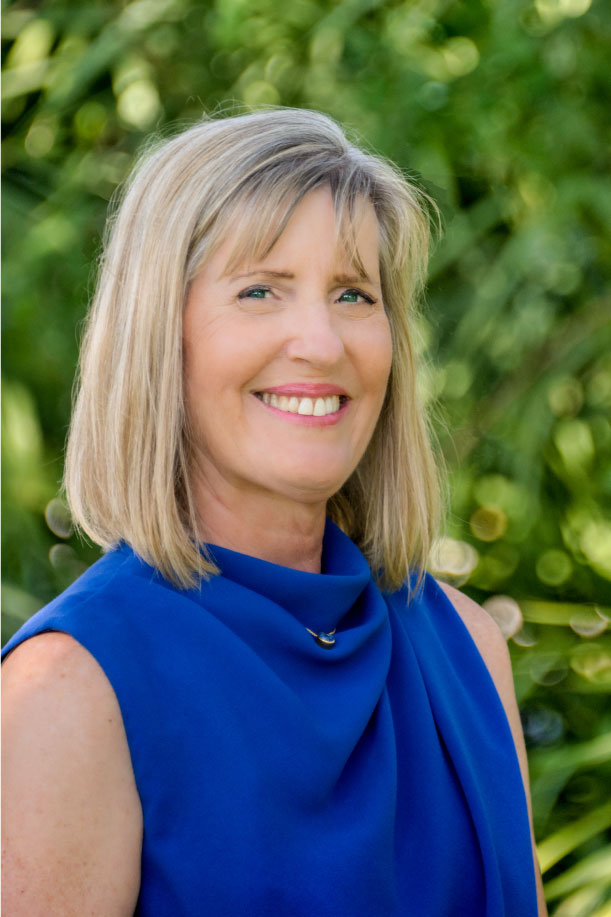
Julie McGue
Author
One night at a teen sleepover, my friend and I, weary of the erratic darts and squiggles on the Ouija board, climbed into our sleeping bags.
She turned to me and asked, “You’re adopted, right?”
Through my clenched jaw and prickly braces, two clipped words slipped out. “Uh . . . yeah.” Then, like a boxer in the waning phase of his career, I waited for the sucker punch I knew would follow.
“What happened to your real parents?”
I can still feel the uncomfortable heat in my sleeping bag as I began to sweat. In response, I probably muttered something like I dunno, but inwardly I desperately wished that this question hadn’t been posed. The shame of not knowing anything about my birth parents or my background festered until I located them in 2011 and 2014.
We have all fielded or launched them: difficult questions that leave the respondent feeling befuddled, angry, anxious, amused, or speechless. Queries like: Why do you think your marriage failed? How does it feel to be a widow? Don’t you think you should watch your expenses at a time like this? Or even: Shouldn’t you be wearing a mask?
If the environment is your workplace and it’s your boss asking, then you have no choice but to offer some reply. When dealing with co-workers, friends, or the nosy woman across the hall, you have the option of politely declining to respond. Even so, experts agree that it’s best not to dodge a difficult question completely. Instead, try to offer some sort of response that satisfies the questioner.
Here are three strategies I find helpful:
Ask for clarification. Clarifying the question before formulating an answer is an excellent strategy for confusing questions. My husband and I didn’t always use the same language, so this saved me from going off on the wrong tangent.
Buy time. When dealing with my aging mother, I take my time to respond, mostly because stalling helps me gather my patience. She tends to ask the same questions over and over.
Answer the parts you feel comfortable answering and ignore the rest. One friend of mine, when probed about something personal, is famous for responding, “What an interesting question!” or “You pose a really good question.” Her words are part deferral and part buying time. She almost always skips any parts of the question she isn’t comfortable responding to. This I deeply admire.
Important to note. Just because someone launches a query doesn’t mean their question requires your attention.
I adopted these strategies later in life when I had to figure out how to handle the inevitable probes adoptees face. My mom taught me many things, but it would have been great if, along with the birds-and-bees talk, she had given me a lesson on how to answer difficult questions about my adoption.
Here’s the thing, though. When you know a question will keep coming your way, you perfect a response. That dopey answer I offered at a teen sleepover—“I dunno”—morphed into other responses once I matured. For a while, I simply said, “It was a closed adoption. I have no information.” Now, I’m fast to dish this out: “Do you have a few moments? Do you want the short or long version? I recently completed my adoption search, and I’m in reunion . . .”
So, why have I grown comfortable discussing my adoption? Because it allows me to talk about my memoir, my adoption blog, and other writing I’m working on. The knowledge I gained as I researched my adoption fills me with ease, and it erased the shame of all those years of not knowing.
Regarding handling other difficult questions, I still like my friend’s approach best. “What an interesting question” buys you time to defer, decline, evade, and pick which part of a full response you wish to share.
(A version of this column appears in my collection of essays, Belonging Matters: Conversations on Adoption, Family, and Kinship, available wherever books are sold.)
Follow Me Here
July 24-27: Julie will attend the Understory Writer’s Conference in Park City, Utah. This intimate conference organized by writers for writers will celebrate the art of storytelling with a focus on the natural environment.
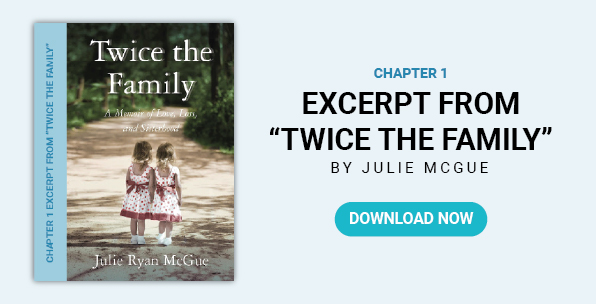
Aug. 3-5 Julie was selected to present her book, Twice the Family, at the SIBA/NAIBA’s joint fall conference, “New Voices New Rooms,” in Atlanta on Aug. 4 from 5-6:30 ET.
Aug. 13: Julie will join the Adoption Knowledge Affiliates Book Club at 7 PM CT to discuss Twice the Family.
Aug. 20 and Sept. 10: Julie will be presenting an online webinar, “Memoir Magic: Mining Journals to Craft Compelling Memoir” for the Author Learning Center at 1:30 ET. Go here to register.
Aug. 24-28: Julie will attend the HerSpirit Women’s Writing Retreat at the Chaminade Resort & Spa in Santa Cruz, CA organized by Story Summit.
Sept. 7: Julie will showcase her books at Printer’s Row LitFest on south Dearborn in downtown Chicago from 10-2 PM. Look for Julie in the Chicago Writer’s Association booth.
Other News
Twice the Family was named the winner in Memoir category for the National Indie Excellence Awards!
Julie’s essay, “Bond Unbroken: Growing Up Adopted with My Twin” will appear in the July issue of Multiples Connection put out by Multiples of America Organization.
Follow Julie by visiting her website, subscribe to her bimonthly newsletters, and listen to previous podcast recordings where she discusses topics like adoption, identity, family relationships, sisterhood and belonging.
“Regarding handling other difficult questions, I still like my friend’s approach best. “What an interesting question” buys you time to defer, decline, evade, and pick which part of a full response you wish to share.”
Don’t miss a blog post!
Receive my blog posts directly to your inbox.